Table of Contents
- Common Identity Discrepancies in Citizenship Applications
- Step 1: Gather Your Vital Records and Identify the Mismatch
- Step 2: Amending Birth Certificate for Dual Citizenship
- Step 3: When and How to Use an Affidavit of One and the Same Person Template
- Step 4: Submit Your Application and Track Your Progress
- How Long Does It Take to Correct Vital Records?
- Common Mistakes to Avoid When Fixing Identity Discrepancies
- Frequently Asked Questions
Last Updated: September 25, 2026
Common Identity Discrepancies in Citizenship Applications
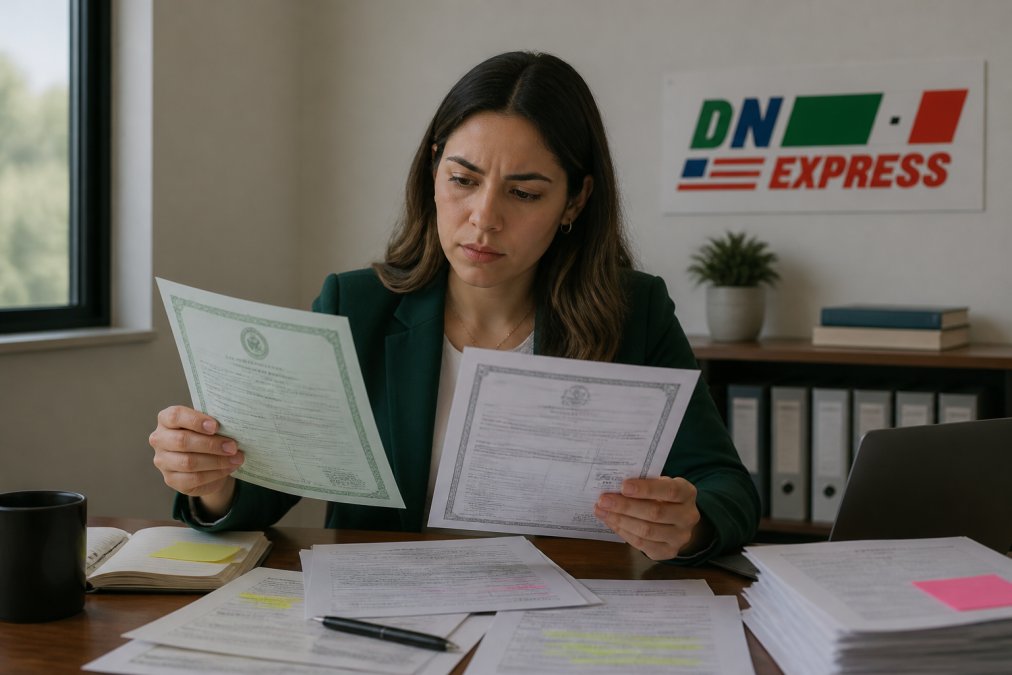
Identity discrepancies are mismatches between the personal details on your documents and the details in official government records. Even small differences can stall a dual citizenship application for months. This guide from Doble Nacionalidad Express (DNExpress) explains how to fix them.
Name and Surname Variations
Name variations are the most frequent problem. A single letter, a flipped order, or a missing accent can trigger a rejection.
Common examples include:
- “Sanchez” on one document, “Sanches” on another
- A maiden name on one record, a married name on another
- A nickname like “Lupe” instead of “Guadalupe”
- Surname order reversed between U.S. and Mexican records
Date and Place of Birth Mismatches
A date of birth mismatch is harder to explain than a spelling difference; even a one-day gap raises questions.
Watch for these:
- Different birth dates across a birth certificate, passport, and school record
- A city or state name spelled differently in translation
- A hospital name that no longer matches the official record
Parental Information Inconsistencies
Parental name inconsistency can block an application even when your own details are correct. Your parent’s name must match across every document in the chain.
Look out for:
- A mother’s maiden name missing on one record
- A father’s name spelled two different ways
- A parent listed under a nickname or shortened form
Step 1: Gather Your Vital Records and Identify the Mismatch
Collect every document that carries your personal details; you cannot fix a mismatch until you know where it lives.
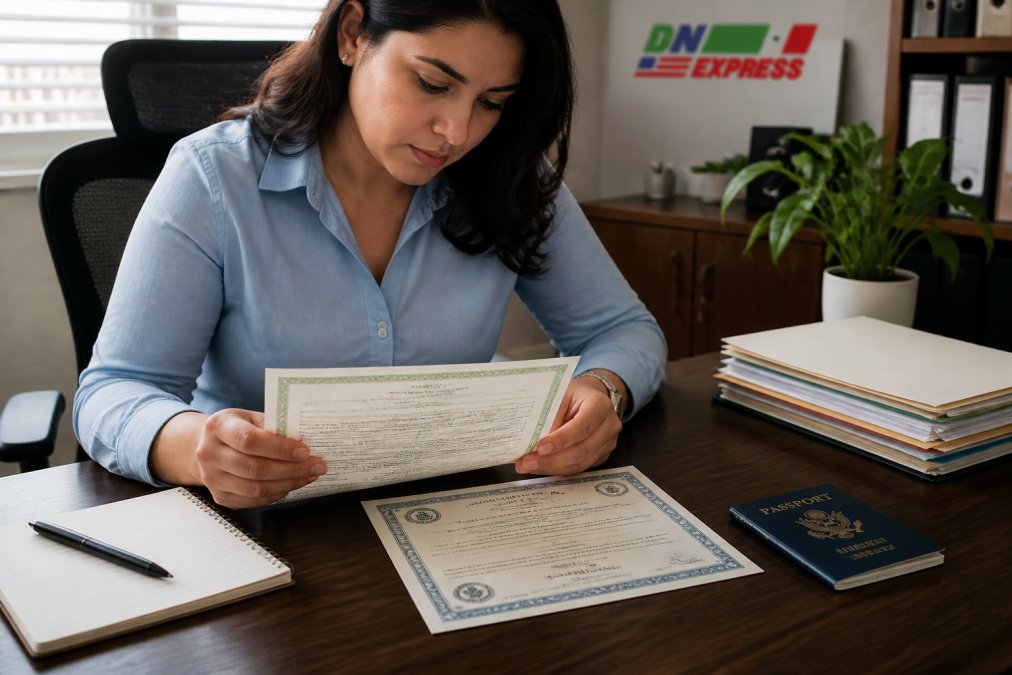
Pull together these records:
- Birth certificate (both U.S. and any foreign record)
- Current passport and any expired passports
- Government-issued ID
- Marriage or divorce certificates, if applicable
- Your parents’ birth certificates and marriage record
- School, baptismal, or medical records that list your details
Step 2: Amending Birth Certificate for Dual Citizenship
Amending a birth certificate for dual citizenship means filing a formal correction request with the issuing office. The process differs by county, and the biggest mistake is treating “fix the birth certificate” as one task. It is three: the source record, the translation, and any downstream document that copied the error.
U.S. Vital Record Amendments
In the United States, corrections go through the vital statistics office in the issuing state. Each state sets its own rules, forms, and fees, so there is no national procedure.
Most states ask for:
- A completed amendment application form
- A certified copy of the current birth certificate
- Supporting documentation that proves the correct information
- A notarized affidavit explaining the error
- Payment of the state’s amendment fee
Mexican Birth Certificate Corrections
For a Mexican record, the correction is filed through the civil registry holding the original entry, typically the Registro Civil in the state where the birth was registered, and is built around the original acta, not a copy.
The civil registry typically requires:
- The original birth certificate, called an acta de nacimiento
- Proof of the correct information
- Identification of the person requesting the change
- A formal written request
- Payment of the applicable fee
Irish and Italian Records: A Quick Contrast
Applicants pursuing citizenship through descent often deal with Irish or Italian records, where the amendment logic differs again.
When the Record Cannot Be Amended
Some records cannot be corrected: the office may be closed, the original book lost, or the law may bar changes after a certain number of years. When that happens, you do not abandon the application, you bridge the gap with an affidavit, covered next.
Step 3: When and How to Use an Affidavit of One and the Same Person Template
An affidavit of one and the same person is a sworn statement confirming two different name versions belong to the same individual. It is the bridge document you use when a record cannot be corrected and you must connect the dots for the reviewing authority.
When the Affidavit Is the Right Tool
The affidavit fits specific situations:
- A nickname appears on an old record that cannot be amended
- A spelling variation exists across documents from different countries
- A maiden name and married name both appear in your document chain
- A record was lost, destroyed, or is held by an office that no longer exists
- A translation introduced a variation that the source record does not support
It is not a substitute for an amendment when one is available. Reviewing authorities prefer a corrected source record, and some consulates reject an affidavit if the underlying record could have been fixed. Use it only when the record genuinely cannot be changed, and be ready to explain why.
What the Affidavit Must Contain
I, [Full Legal Name], being duly sworn, declare that I am also known as [Alternate Name]. I confirm that both names refer to the same person, myself. The variation appears due to [reason: translation, clerical error, or customary use]. I declare under penalty of perjury that the statements above are true.
Signature: _______________ Date: _______________ Notary Public: _______________
That template is a starting point, not a finished document. A strong affidavit also:
- Lists every name variation, not just two
- Identifies the documents where each variation appears
- States the reason for each variation separately, if the reasons differ
- Attaches copies of the documents being reconciled
- Is signed before a notary
Notarization, Apostille, and Translation
Get the affidavit notarized; a notarized affidavit carries legal weight an unsigned statement does not.
How the Affidavit Fits the Evidence Chain
The affidavit does not stand alone. It sits inside a chain of evidence running from the oldest record to the newest, and the reviewing authority asks one question: does every document describe the same person?
Step 4: Submit Your Application and Track Your Progress
Once your records match, assemble the full application, submit it, and track it.
Before you submit, confirm:
- Every certified copy is included
- Translations are certified and complete
- The affidavit, if used, is signed and notarized
- Your application form matches your corrected records
How Long Does It Take to Correct Vital Records?
There is no single answer: the timeline depends on the office, the type of fix, and the country. A simple typo correction often moves faster than a change requiring a court order.
Expect the process to move in stages:
- Record search and review: varies by office
- Amendment filing and processing: depends on the issuing authority
- Translation and certification: adds time if documents cross borders
- Application review: set by the consulate or registry handling your case
Common Mistakes to Avoid When Fixing Identity Discrepancies
Mistakes here cost time, and sometimes money. Avoid these five.
- Fixing the wrong document. Correct the record that does not match, not the one that is already right.
- Using uncertified translations. Always use certified translations for any document in a foreign language.
- Skipping the affidavit. If a record cannot be amended, the affidavit bridges the gap. Do not leave it out.
- Submitting copies instead of certified copies. Most offices reject plain photocopies.
- Ignoring a small mismatch. A single letter or digit can trigger a rejection. Fix everything, even the tiny stuff.
Frequently Asked Questions
Can minor spelling errors on vital records delay my citizenship application?
Yes, even a single letter difference in a name or date can stall your dual citizenship application. Consulates treat any mismatch as a potential fraud risk and will request additional evidence. Common fixes include a notarized affidavit of one and the same person or an amended vital record. Correcting the error before submitting saves weeks of back-and-forth.
Do I need a court order to correct a name discrepancy for citizenship purposes?
Not always. Many administrative corrections, like fixing a typo on a birth certificate, can be done through your state’s vital statistics office without a judge. But if the discrepancy involves a legal name change or conflicting parental information, a court order of competent jurisdiction may be required. A consultation with a document specialist can clarify which path applies to you.
What is an affidavit of one and the same person?
It is a sworn statement, often notarized, that declares two different name variations belong to the same individual. For example, if your U.S. passport says ‘Maria Lopez’ but your Mexican birth certificate says ‘Maria Lopez Garcia,’ this affidavit bridges the gap. It is commonly used when amending records is impractical or impossible, and it must be accompanied by supporting documentation.
How long does it take to correct vital records for dual citizenship?
Timelines vary by state and country. A U.S. vital record amendment might take 4 months, while a Mexican birth certificate correction can take 2-6 months depending on the registry’s workload. Incomplete submissions cause most delays. Working with a service that reviews your documents before filing can cut weeks off the process.
Fixing identity discrepancies takes patience, and the paperwork can feel endless. Doble Nacionalidad Express (DNExpress) was built for exactly this problem. We review your documents, handle the correction filings, manage correspondence with the authorities, and keep you updated at every stage. Our remote processing options mean you can start from home. Get started with Doble Nacionalidad Express (DNExpress) and move your dual citizenship application forward with confidence.