Table of Contents
- Understanding Birth Certificate Name Discrepancies
- Required Documentation for Birth Certificate Amendment
- Step-by-Step Process to Correct Your Birth Certificate
- How Long Does It Take to Correct a Birth Certificate
- Court Order for Name Change on Birth Certificate
- Correcting Clerical Errors vs. Legal Name Changes
- Troubleshooting Rejected Applications
- Professional Assistance for Complex Cases
- Frequently Asked Questions
Last Updated: September 21, 2026
Understanding Birth Certificate Name Discrepancies
A birth certificate name discrepancy occurs when the name on your vital record doesn’t match other official documents or records. These gaps between documents create real problems when applying for citizenship, passports, or property ownership.
Name discrepancies happen more often than you’d think. A misspelled first name. A maiden name recorded instead of a married name. A nickname listed instead of your legal name. These small errors can block your entire citizenship application.
The process isn’t complicated, but it requires the right documents and paperwork filed with the correct vital records office.
The fastest way to fix a discrepancy is identifying the exact error before you contact the vital records office. Pull together all your documents first, birth certificate, passport, CURP, any legal name change orders. Compare them side by side. Write down exactly what’s different.
Required Documentation for Birth Certificate Amendment
Identifying Your Supporting Documents
You’ll need proof that the name on your birth certificate is wrong. The vital records office won’t change anything without solid evidence.
Common supporting documents include:
- Original birth certificate
- Passport or identification card
- Marriage certificate (if name changed due to marriage)
- Divorce decree (if reverting to maiden name)
- Court order for legal name change
- Baptism or religious records
- School records with correct name
- Driver’s license or state ID
The specific documents you need depend on why the name is wrong. If your parents registered you with a nickname instead of your legal name, you might need a baptism certificate or school records. If there’s a clerical error, an affidavit from a parent or witness often works.
Notarization and Verification Requirements
Many states require supporting documents to be notarized. A notarized document carries an official seal and the notary’s signature, proving the document is genuine.
When you’ll need notarization:
- Affidavits from parents or witnesses
- Sworn statements about the correct name
- Certified copies of older documents
- Documents from outside the United States
A notary public can notarize documents at banks, law offices, or shipping centers. Bring your original documents and valid identification. The notary will verify your identity, have you sign the document in front of them, and add their official seal.
Some vital records offices accept photocopies of notarized documents. Others require originals. Call your state’s vital records office before getting documents notarized to confirm what they’ll accept.
Do NOT submit original documents unless the vital records office specifically asks for them. Always send certified copies or photocopies. Original documents can get lost in the mail or during processing. Keep originals in a safe place.
Step-by-Step Process to Correct Your Birth Certificate
Step 1: Contact the Vital Records Office
Start by reaching out to the vital records office in the state where you were born. Each state has its own process and forms.
How to find your vital records office:
- Search “[your state] vital records office” online
- Call the state health department
- Visit the state’s official website
- Look for the vital statistics division
When you call, explain the name discrepancy clearly. Ask what documents they need and which form to submit. Ask about processing times and fees. Some offices have expedited processing options if you need the corrected certificate quickly.
Write down the office’s contact information, the person’s name you spoke with, and the date of your call. You’ll need this information later.
Step 2: Submit Your Correction Application
Complete the amendment form your vital records office provides. The form varies by state, but all ask for basic information about the birth record and the correction you’re requesting.
What to include with your application:
- Completed amendment form
- Copy of the original birth certificate
- Supporting documents proving the error
- Notarized affidavit (if required)
- Proof of your identity
- Cover letter explaining the discrepancy
Write a clear, brief cover letter. Explain what name is on the certificate, what the correct name should be, and why. Attach it to the front of your application. This helps the vital records office understand your request immediately.
Make copies of everything before mailing. Keep one set for your records. Mail your application to the address the vital records office provides. Use certified mail with tracking so you know when it arrives.
Step 3: Pay the Application Fee
Vital records offices charge fees for amendments. Fees vary by state, typically ranging from modest amounts to higher costs depending on the state and type of correction.
Payment methods:
- Check or money order
- Credit or debit card (if paying online)
- Money order (if mailing)
Include the payment with your application. Make checks payable to the vital records office or the state health department.
Step 4: Receive Your Corrected Certificate
Once the vital records office approves your application, they’ll send you the corrected birth certificate. This usually arrives by mail within the processing timeframe they quoted.
How Long Does It Take to Correct a Birth Certificate
Processing times for birth certificate corrections vary significantly by state. Some states process amendments in 2-4 weeks. Others take 6-8 weeks or longer.
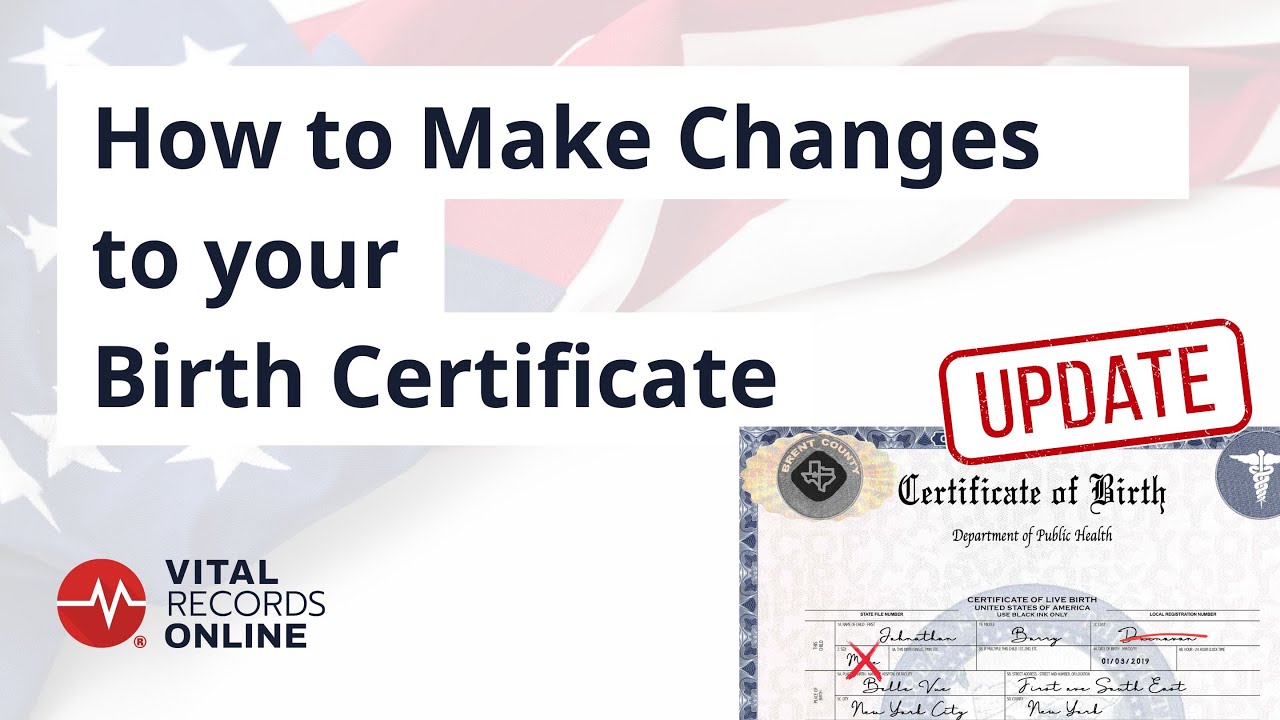
How to Make Changes to Your Birth Certificate | Vital Records Online
Vital Records Online
Typical processing timeframes:
- Standard processing: 4-8 weeks
- Expedited processing (if available): 1-2 weeks
- Complex cases with additional review: 8-12 weeks or more
Incomplete applications take much longer to process. The vital records office will contact you if documents are missing, which adds weeks to your timeline. Submit everything they ask for the first time.
Court Order for Name Change on Birth Certificate
When a Court Order Is Required
Some birth certificate corrections require a court order. You can’t fix these issues directly through the vital records office.
Situations requiring a court order:
- Legal name change (changing your name for personal reasons)
- Paternity establishment or denial
- Removing or adding a parent
- Correcting gender marker
- Changing surname after adoption
How to Obtain a Court Order
Contact your county’s family court or probate court. Explain that you need a court order for a birth certificate correction.
The court process typically involves:
- Filing a petition with the court
- Paying court filing fees
- Attending a hearing (sometimes)
- Receiving a signed court order
- Submitting the order to vital records
Correcting Clerical Errors vs. Legal Name Changes
A clerical error is a mistake made when the birth certificate was originally recorded. A legal name change is a deliberate change to your name after birth.
Clerical errors include:
- Misspelled first or last name
- Wrong middle name or initial
- Transposed letters or numbers
- Name recorded phonetically instead of correctly
- Nickname instead of legal name
Legal name changes require court orders because:
- You’re intentionally changing your identity
- The change affects legal rights and obligations
- A judge must approve the change
- The process creates an official record of the change
Troubleshooting Rejected Applications
Common Reasons for Rejection
Vital records offices reject applications when documentation is incomplete, unclear, or doesn’t support the requested correction.
Frequent rejection reasons:
- Missing supporting documents
- Illegible or incomplete application form
- Documents not notarized when required
- Insufficient proof of the error
- Wrong vital records office (birth in different state)
- Application submitted to wrong address
- Payment missing or incorrect amount
- Identity not verified with acceptable ID
How to Resubmit After Rejection
Don’t give up if your application is rejected. Most rejections are fixable.
Steps to resubmit:
- Gather the missing or corrected documents
- Complete a new application form (if requested)
- Write a cover letter explaining the additional documents
- Include all previous paperwork plus new materials
- Resubmit to the same vital records office
If your application is rejected twice, consider professional assistance. DNExpress specializes in resolving document discrepancies and can handle complex cases that vital records offices initially reject. Our team provides professional support.
Professional Assistance for Complex Cases
Some birth certificate name discrepancies are too complicated to handle alone. Missing documents. Conflicting information across records. Parents who are deceased or unavailable. These situations benefit from professional help.
Frequently Asked Questions
How do I fix a misspelled name on my birth certificate?
Contact your state’s vital records office to request a correction form. Submit the form with supporting documentation that proves the error (such as a hospital record, baptism certificate, or affidavit). For minor clerical errors like spelling mistakes, most states allow corrections without a court order. Processing times vary by state but typically range from 2 to 8 weeks. Your vital records office will guide you through their specific requirements and fees.
What supporting documents do I need for a birth certificate amendment?
Supporting documents for birth certificate amendment typically include the original birth certificate, a completed correction request form, government-issued identification, and evidence of the error. For name discrepancies, you may need hospital records, baptism certificates, school records, or a notarized affidavit from someone with knowledge of the facts. Some states require certified copies of documents. Check with your state’s vital records office for their specific list, as requirements vary.
Do I need a court order to change a name on my birth certificate?
A court order for name change on birth certificate is required in some situations but not all. Minor clerical errors (like spelling mistakes) typically don’t require a court order. However, if you’re making a substantial change to a name or if the vital records office denies your correction request, you may need to petition the court. Legal name changes initiated after birth always require a court order. Contact your state’s vital records office to determine whether your situation requires court involvement.
How long does it take to correct a birth certificate?
How long does it take to correct a birth certificate depends on your state and the complexity of your case. Standard corrections typically take 2 to 8 weeks from the time you submit your application. Some states offer expedited processing for an additional fee, which can reduce the timeline to 1 to 2 weeks. If your case requires a court order or additional investigation, the process may take several months. Contact your vital records office for their current processing times.