Table of Contents
- What Dual Citizenship Means for Mexican Americans
- Mexican Dual Citizenship Requirements You Must Meet
- Step-by-Step: Registering at a Mexican Consulate
- How Long Does Mexican Dual Citizenship Take?
- Benefits of Mexican Dual Citizenship
- Renunciation vs. Dual Nationality: What You Need to Know
- After Registration: Passports, CURP, and Next Steps
- Frequently Asked Questions
Last Updated: September 18, 2026
What Dual Citizenship Means for Mexican Americans
Dual citizenship for Mexican Americans means holding U.S. and Mexican nationality at once. It lets you live, work, and own property in Mexico without visa limits while keeping your U.S. passport.
Citizenship by Birth vs. Naturalization
Citizenship by birth means you got Mexican nationality automatically at birth, if you were born in Mexico, or if at least one parent was Mexican, even if you were born in the United States.
The 1998 Nationality Law and Dual Allegiance
Mexico’s Nationality Law of 1998 ended the old rule that forced people to renounce one nationality to keep the other. You can now hold dual allegiance without losing either citizenship, and Mexican law treats your Mexican nationality as something you never fully lose. The U.S. State Department does not require you to give up your American citizenship when you take another.
Mexican Dual Citizenship Requirements You Must Meet
The main Mexican dual citizenship requirements come down to proof of lineage and identity: you must show you are the child of a Mexican parent and that your documents match across both countries. Most applicants need:
- A Mexican birth certificate for your parent, or proof they were born in Mexico
- Your own U.S. birth certificate showing that parent’s name
- Valid photo ID, such as a U.S. passport
- A completed registration form from the consulate
- Proof of any name or date corrections you have made
A common mistake is submitting documents with mismatched names or dates. If your mother’s maiden name is spelled one way on your birth certificate and another way on her Mexican records, the consulate can reject the file before review. Fix the mismatch first, or the whole application waits.
Documents You’ll Need to Gather
Gather originals and copies of everything before you book anything. Missing paperwork is the top reason appointments get rescheduled.
- Your U.S. birth certificate, long form
- Your Mexican parent’s birth certificate
- Your current U.S. passport
- A government-issued photo ID
- Marriage certificates if names changed
- Any corrected vital records
U.S. State Department guidance on apostilles and authentications
Step-by-Step: Registering at a Mexican Consulate
- Confirm your eligibility through parental lineage.
- Gather and review all documents for errors.
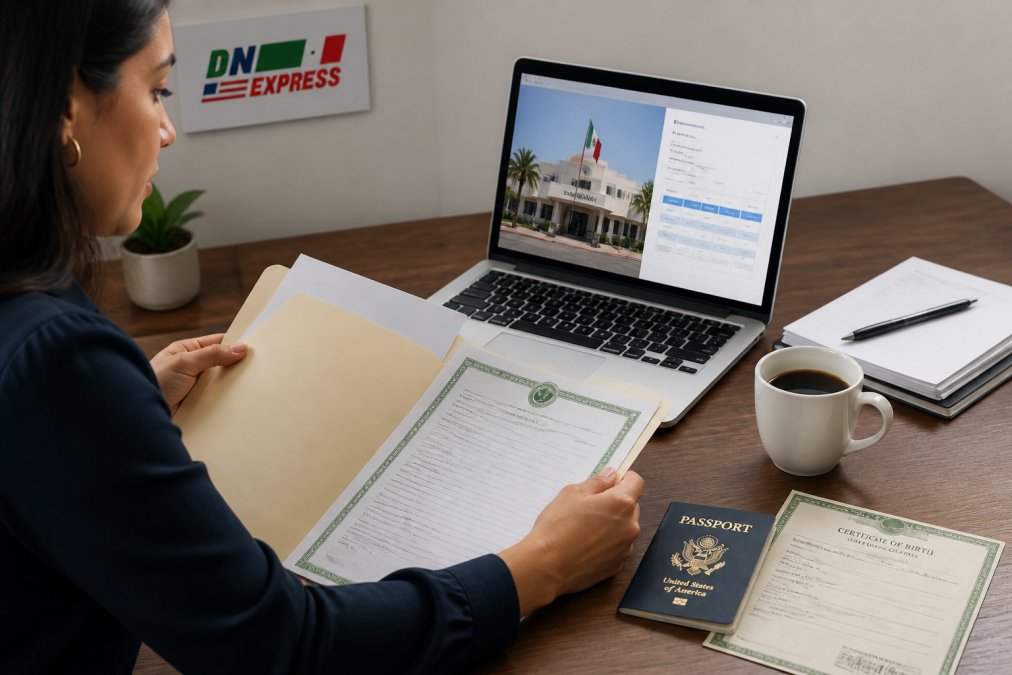
- Create an account and book a consular appointment through the Mexican government’s online appointment system (the SRE portal, often reached through the MiConsulado / MiConsulmex interface for your specific consulate).
- Complete the registration form the consulate provides, typically the application for a “Constancia de Nacionalidad Mexicana” or the registration of a birth occurring abroad.
- Attend your appointment with originals and photocopies of every document.
- Submit your application and pay the consular fee (fees are set in Mexican pesos and adjusted periodically; confirm the current amount on your consulate’s page before you go).
- Wait for the civil registry to process your file.
- Receive your certificate of nationality.
Navigating the Appointment Portal Without Wasting Trips
The appointment system is the biggest source of lost time. A few patterns hold across most consulates:
- Slots release in batches, not continuously. Many offices open appointments on a rolling schedule, so check daily.
- Each consulate sets its own document checklist. Two offices in the same state can ask for different proof of the Mexican parent’s nationality. Pull the checklist from your specific consulate’s page, not a general guide.
- The portal may require you to upload scans before the slot is confirmed. Blurry scans or the wrong file type can make the booking fail silently.
- Cancellations reappear. Refreshing the portal in the days before a target week often surfaces released slots.
Book your appointment the moment your documents are ready, not before. Many consulates tie the appointment to a specific document set, and rescheduling can push you back by weeks. If you can only get a slot far out, take it, a held slot beats an open search.
What to Expect at Your Consular Appointment
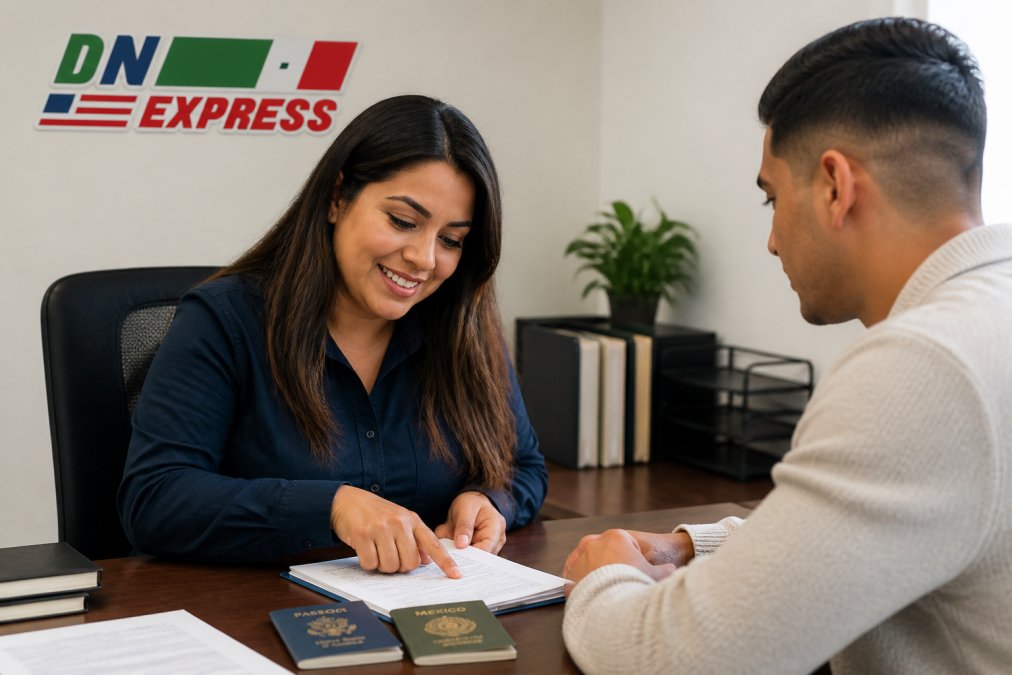
A consular officer reviews your documents in person against the civil registry, takes fingerprints and a photo for biometric data, and compares names and dates line by line. The officer may ask about your parent’s birthplace, your grandparents’ names, and your family history, bring extra proof like old Mexican voter IDs, school records, or a parent’s passport to resolve discrepancies on the spot.
A common mistake is submitting documents with mismatched names or dates. If your mother’s maiden name is spelled one way on your birth certificate and another way on her Mexican records, the consulate can reject the file before review. Fix the mismatch first, or the whole application waits.
Documents You’ll Need to Gather
Gather originals and copies of everything before you book anything. Missing paperwork is the top reason appointments get rescheduled.
- Your U.S. birth certificate, long form
- Your Mexican parent’s birth certificate
- Your current U.S. passport
- A government-issued photo ID
- Marriage certificates if names changed
- Any corrected vital records
U.S. State Department guidance on apostilles and authentications
The consulate step is where preparation pays off. A clean, consistent document set with the right apostilles turns a multi-visit ordeal into a single appointment.
How Long Does Mexican Dual Citizenship Take?
Most applicants wait several weeks to a few months, and how long Mexican dual citizenship takes depends on your documents and consulate. Clean files move fast; files with errors move slowly. The timeline has three parts:
| Stage | Typical Time | What Slows It Down |
|---|---|---|
| Document prep | 2-8 weeks | Missing or mismatched records |
| Consular appointment | 1-6 weeks | Limited appointment slots |
| Registry processing | 4-12 weeks | Document verification checks |
Benefits of Mexican Dual Citizenship
The benefits of Mexican dual citizenship go well beyond paperwork. You gain rights in two countries at once.
- Live in Mexico without visa restrictions
- Own property in Mexico without special permits
- Access Mexican healthcare and education systems
- Travel visa-free or with visa-on-arrival to over 160 countries
- Pass Mexican nationality to your children
- Keep your full U.S. citizenship and passport
Renunciation vs. Dual Nationality: What You Need to Know
Renunciation is giving up one citizenship on purpose; dual nationality means keeping both. You do not have to renounce U.S. citizenship to become Mexican, and you do not have to renounce Mexican citizenship to stay American, the old fear that one cancels the other no longer applies.
You can hold both citizenships for life. Renunciation is a choice, not a requirement, and it is rarely the right move for someone with family ties in both countries.
After Registration: Passports, CURP, and Next Steps
Registration is not the finish line. After you receive your certificate of nationality, you can apply for a Mexican passport and get your CURP, the part most guides skip, and where the practical value of dual nationality shows up.
Getting Your CURP and Mexican Passport
- CURP: Request it through the civil registry or the Mexican government’s CURP portal. Your certificate of nationality proves your right to one. The code is issued under the name exactly as it appears on your Mexican records, which is why fixing name mismatches before registration matters.
- Mexican passport: Apply at a consulate or an SRE office in Mexico. You will need your certificate of nationality, your CURP, photos to the required specification, and the applicable fee. Passports come in several validity terms, and the fee scales with the term you choose.
- Voter credential (if you want it): Mexican citizens abroad can register for a consular voter ID, which doubles as a widely accepted photo ID in Mexico.
Mexican government portal for CURP and civil registry services
Updating Your U.S. Records
Dual nationality does not change your U.S. records automatically, and you usually are not required to notify anyone. A few updates are still worth making:
- Social Security: If your name changed as part of the process (for example, to match your Mexican documents), update your Social Security record so your earnings history stays consistent.
- U.S. passport: You keep your U.S. passport and use it to enter and leave the United States. Do not use your Mexican passport to enter the U.S. as a citizen, U.S. citizens are required to enter on a U.S. passport.
- State and local records: Update your driver’s license, voter registration, and any professional licenses if your legal name changed.
Taxes: What Dual Status Actually Means
The United States taxes citizens on worldwide income regardless of where they live, and Mexico taxes residents on worldwide income and non-residents on Mexican-source income. Holding both nationalities does not create a new tax by itself, but it can create filing obligations in both countries if you live, work, or earn income in Mexico.
Do not assume dual nationality is tax-neutral just because you never lived in Mexico. Rental income from Mexican property, Mexican bank interest, and even some pension or investment income can trigger a Mexican filing obligation. Get advice before the first tax year closes, not after.
Property, Inheritance, and Banking
Dual nationality simplifies several things that are hard for non-citizens:
- Property: Mexican citizens can own property outright in most of the country. In the restricted zone near the coast and borders, non-citizens historically needed a bank trust (fideicomiso); citizens have more direct options, though rules vary by location.
- Inheritance: Mexican inheritance law and U.S. estate law operate separately. A Mexican will (testamento) is the cleanest way to direct Mexican assets and avoids the default intestate rules that can surprise U.S.-based heirs.
- Banking: A CURP and Mexican identification make it far easier to open accounts, sign contracts, and register with the tax authority (SAT) if you need to.
Storing and Using Your Documents
- Keep certified copies of your certificate of nationality, CURP, and both passports in separate secure locations.
- Carry the passport matching the country you are entering: U.S. passport for the United States, Mexican passport for Mexico.
- Renew each passport on its own schedule; they do not expire together.
The certificate is step one. The CURP, the Mexican passport, a Mexican will, and a clear tax plan are what turn dual nationality from a document into daily capability. Handle them in the first year, and the status works for you instead of sitting in a drawer.
Frequently Asked Questions
Is there a downside to dual citizenship with Mexico?
Dual citizenship for Mexican Americans carries few real drawbacks. You keep your U.S. citizenship, though you must enter and exit the U.S. using your American passport. Mexico may treat you as a Mexican citizen for tax purposes if you establish tax residency there. Some U.S. government positions requiring security clearances can ask about foreign ties, but holding dual citizenship alone rarely disqualifies applicants. For most people, the benefits of Mexican dual citizenship far outweigh the tradeoffs.
Do I need to renounce my US citizenship to become a Mexican citizen?
No. Since Mexico’s 1998 Nationality Law, you can hold Mexican and U.S. citizenship at the same time without renouncing either one. When you register at a consulate, you may be asked to sign a statement affirming your Mexican nationality, but this does not cancel your U.S. citizenship. The U.S. also allows dual nationality. Renouncing American citizenship is a separate, deliberate legal process you would only pursue if you chose to, not a requirement of Mexican registration.
Can I have a US passport and a Mexican passport at the same time?
Yes. After your citizenship is registered and your Mexican birth certificate or certificate of nationality is issued, you can apply for a Mexican passport at any consulate. You keep your U.S. passport as well. Use your U.S. passport to enter and leave the United States, and your Mexican passport when traveling in Mexico or to countries that grant visa-free access to Mexican citizens. Having both passports is one of the clearest practical benefits of dual citizenship.
I’m a third-generation Mexican-American. Do I still qualify?
It depends on whether your parent or grandparent was a Mexican citizen at the time of your birth. Mexican nationality passes through parental lineage, so if your parent was born in Mexico, you generally qualify regardless of your own birthplace. If your connection runs through a grandparent, eligibility gets more complicated and often requires proving an unbroken chain of citizenship. A consultation can help confirm your eligibility.