Table of Contents
- Step 1: Identify the Error and Confirm It on Your Mexican Birth Certificate
- Common Errors on Mexican Birth Certificates and How They Happen
- Step 2: Gather Supporting Documentation for the Civil Registry
- Step 3: Choose Your Path: Administrative Correction or Judicial Correction
- Step 4: Submit Your Correction Request Through a Consulate or Power of Attorney
- How Long Does It Take to Correct a Mexican Birth Certificate?
- Mexican Citizenship Application Requirements 2026: What Your Corrected Record Must Show
- Frequently Asked Questions
Last Updated: September 16, 2026
Step 1: Identify the Error and Confirm It on Your Mexican Birth Certificate
Before filing anything, pull your record and compare it line by line against every other identity document you hold.
Order a certified copy from the Civil Registry (Registro Civil) in the state where you were registered. From the U.S., most consulates can request it for you, or a family member in Mexico can pull it directly.
Then check these fields against your U.S. passport, your CURP, and any prior Mexican documents:
- Given names and surnames, including accents and spelling
- Date and place of birth
- Parents’ full names, including your mother’s maiden name
- Gender marker
- Registration date and official seal
A common mistake is assuming the error sits in your newer documents. Usually the birth registration is the source, and everything downstream inherited the mistake.
If your CURP and your birth certificate disagree on a surname, the consulate will typically stop processing your application until the record is corrected. Fixing the record first saves you a rejected appointment and a wasted trip.
Common Errors on Mexican Birth Certificates and How They Happen
Most errors fall into a few predictable categories, and knowing which one you have tells you how hard the fix will be.
The most frequent issues we see at Doble Nacionalidad Express (DNExpress) are clerical errors: a misspelled surname, a transposed digit in a birth date, an accent dropped or added, a mother’s maiden name in the wrong field. These stem from handwritten registrations, transcription mistakes, or data-entry slips during digitization.
Then there are omissions: a name missing entirely, a parent left off, or a gender marker recorded incorrectly, usually older records from rural registries where documentation was thinner.
And there are discrepancies between documents rather than errors in the record itself.
Clerical Mistakes vs. Legal Name Changes
These get confused constantly, and the distinction determines your entire process.
Step 2: Gather Supporting Documentation for the Civil Registry
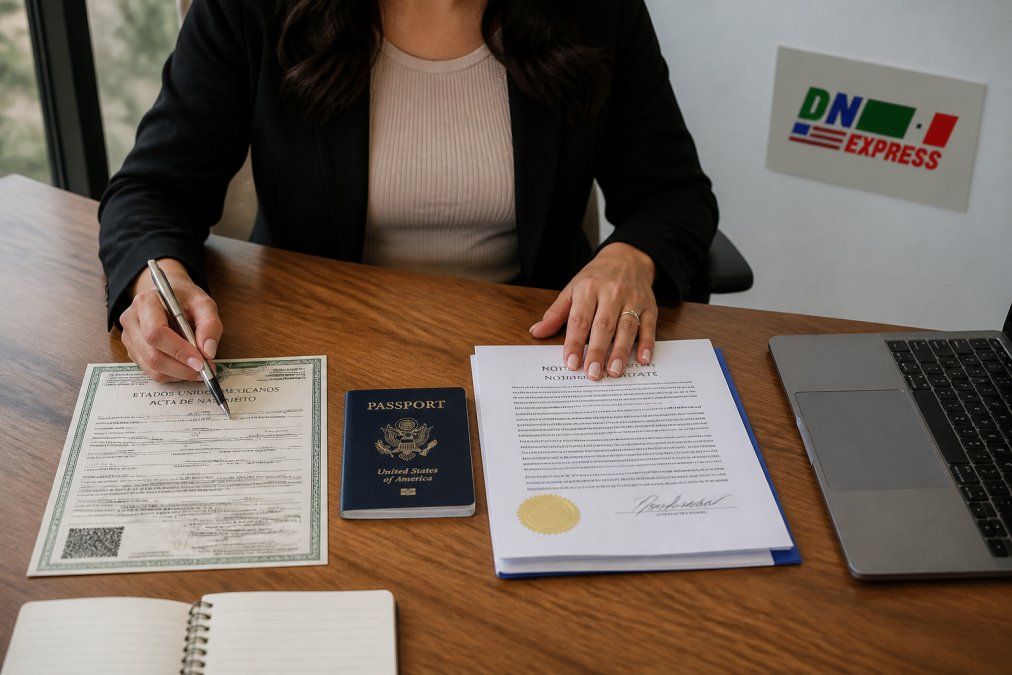
Documentation is where most corrections succeed or stall. The Civil Registry isn’t evaluating your preference, it’s evaluating whether the corrected version is provably true. Every document must prove who you are, prove the correct information, or prove a foreign document is authentic and readable to a Spanish-speaking official.
The Core File
The exact list varies by state and by error type, but a typical administrative correction file includes:
- Certified copy of the birth certificate containing the error
- Government-issued photo ID (passport, consular ID, or voter credential)
- Your CURP printout
- Supporting evidence of the correct information: a baptismal record, hospital record, school record, or an older document showing the accurate spelling
- Notarized Spanish translation of any document not in Spanish
- A power of attorney if someone else is filing on your behalf
Apostille: The Step Most Files Get Wrong
Any document issued in the U.S. that a Mexican authority will rely on needs an apostille under the Hague Apostille Convention before the registry will accept it. That includes your U.S. passport copy if it is being used as identity evidence, your U.S. birth certificate if you are proving a name, and any U.S. court order. The U.S.
Two practical points that trip people up:
- The apostille attaches to the original or a certified copy, not to a photocopy. Order the certified copy first, then apostille it.
- Apostille and translation are sequential, not parallel. Get the apostille, then have the apostilled document translated. A translation of an un-apostilled document is not usable.
Translation Standards
A Mexican registry will not accept a machine translation or one you produced yourself. The standard is a notarized translation by a perito traductor (a state-credentialed translator) or, in some states, a notary-certified translation. It must be attached to the apostilled original, with the translator’s certification page included.
Consulate-Specific Quirks
If filing through a Mexican consulate in the U.S., confirm its document list before assembling anything. Consulates vary on:
- Whether they accept a copy of the apostilled document or require the original
- Whether they require a consular ID (matrícula) in addition to a passport
- Whether they will accept a correction request at all, or only forward it to a specific state registry
The Dual-Citizenship Document Chain
If the correction feeds a citizenship application, your file must establish a consistent identity chain across both countries. The corrected birth certificate, CURP, passport, and U.S. identity documents must agree on names, dates, and parentage. Where they don’t, the application stalls even after the correction is approved.
Order two certified copies of everything before you apostille. Registries occasionally retain originals, and reordering from abroad takes weeks. The second copy costs little and saves a full cycle.
Do not translate before you apostille. A translation of an un-apostilled U.S. document will be rejected, and you will pay for the translation twice.
Step 3: Choose Your Path: Administrative Correction or Judicial Correction
Pick the wrong route and you’ll spend months on a filing that was never going to be accepted. The choice comes down to what you’re changing.
| Situation | Correction Type | Filed With | Court Required |
|---|---|---|---|
| Misspelled surname | Administrative | Civil Registry | No |
| Wrong birth date | Administrative | Civil Registry | No |
| Missing accent mark | Administrative | Civil Registry | No |
| Name change after marriage | Judicial | Family court | Yes |
| Adding a parent | Judicial | Family court | Yes |
| Changing registered given name | Judicial | Family court | Yes |
Step 4: Submit Your Correction Request Through a Consulate or Power of Attorney
You don’t have to fly to Mexico to fix your record. Remote correction is possible, and for most U.S.-based applicants it’s the only practical route.
Power of attorney is the single highest-use document in a remote correction. Without it, someone has to physically appear at the registry. With it, the entire process can run from the U.S.
How Long Does It Take to Correct a Mexican Birth Certificate?
No registry publishes a guaranteed processing time, and any service quoting fixed days is guessing. But the range tracks three variables: the type of correction, the state registry handling your file, and whether your first submission is complete.
Administrative Corrections
A clean clerical fix, a misspelled surname, a dropped accent, a transposed birth date digit, filed with complete evidence typically moves through a state Civil Registry in four to twelve weeks. Higher-volume states (Jalisco, Nuevo León, Mexico City) sit at the longer end; smaller registries clear straightforward files faster. Filing through a consulate that forwards to the registry adds two to four weeks for the relay.
Judicial Corrections
A court-ordered correction adds a family court docket on top of registry processing. Realistic expectations:
- Filing to hearing: one to four months, depending on the court’s calendar
- Hearing to signed order: two to eight weeks
- Order to registry update and reissued certificate: four to twelve weeks
What Actually Causes Delays
The biggest variable is rework. A file rejected for a missing apostille, an untranslated U.S. document, or a name mismatch between the certificate and the CURP goes back to the end of the queue, each rejection cycle can add four to eight weeks. Applicants who submit a complete, correctly authenticated package the first time finish in roughly half the time of those who submit piecemeal.
Timeline by Submission Method
| Method | Typical Added Overhead |
|---|---|
| In person at state registry | Baseline |
| Consulate-forwarded request | +2 to 4 weeks (relay) |
| Power of attorney via representative | +1 to 3 weeks (coordination) |
| Mail-in from the U.S. | +3 to 6 weeks (postal + intake) |
Planning Around Deadlines
If the corrected record feeds a citizenship application, property closing, or marriage abroad, start at least six months before you need the certificate in hand. Administrative corrections can finish faster, but you can’t count on the fast path until the registry accepts your file. Build in the buffer, not the hope.
There is no universal timeline, but there is a predictable shape: administrative corrections in weeks, judicial corrections in months, and every rejection cycle adding weeks. Submit complete the first time and you control the only variable you actually can.
Mexican Citizenship Application Requirements 2026: What Your Corrected Record Must Show
A corrected record only helps if it satisfies what the application demands. The Mexican citizenship application requirements 2026 put identity consistency at the center of the review.
Frequently Asked Questions
Can you amend your birth certificate online?
Not entirely. Most Mexican Civil Registry offices require original documents or certified copies submitted in person or through a power of attorney. Some states have online portals for initiating a request, but you still need to mail or deliver physical paperwork. For U.S.-based applicants, a consulate appointment or a representative in Mexico handles the submission. Expect to provide your birth certificate, photo ID, and supporting evidence for the error.
How much does a Mexican birth certificate cost?
Fees vary by state and by whether you request a certified copy or an amendment. Civil Registry offices charge different amounts for a simple copy versus a correction. If you hire a service or attorney, their fees are separate. Pricing depends on the specific error and documents involved. Contact DNExpress for a personalized quote based on your situation.
Can I correct my birth certificate at a consulate?
Mexican consulates in the U.S. can help you start the process, but final approval comes from the Civil Registry in the state where your birth was registered. Consulates authenticate signatures, notarize documents, and forward requests. For complex errors like a misspelled surname or missing parental information, you may need a power of attorney to act on your behalf in Mexico. DNExpress coordinates with consulates and Civil Registry offices to manage this remotely.
What documents are required to amend a foreign birth record?
You typically need your original Mexican birth certificate, a valid U.S. passport or government ID, proof of the correct information (such as a U.S. birth certificate or school record), and a notarized translation if your supporting documents are in English. Some states also require an apostille on U.S. documents. A power of attorney is necessary if you cannot appear in person. Requirements differ by state, so verify with the specific Civil Registry office.