Table of Contents
- Mexican Citizenship by Descent Requirements
- Documents Needed for Mexican Citizenship
- Mexican Naturalization Process Timeline
- The History and Culture Test: What to Expect
- Dual Nationality Rules and Renunciation of Previous Citizenship
- Post-Naturalization Steps: Passport, CURP, and Tax Implications
- Common Mistakes and How to Avoid Them
- Frequently Asked Questions
Last Updated: September 13, 2026
Mexican Citizenship by Descent Requirements
Mexican citizenship by descent is the legal recognition that you are Mexican because a parent or grandparent was born in Mexico, regardless of where you were born. This pathway matters because it bypasses the residency timeline that naturalization demands, and it is the route most U.S. citizens of Mexican heritage qualify for. At Doble Nacionalidad Express (DNExpress), we handle the paperwork and consulate correspondence that trip up most applicants.
Who Qualifies Through a Parent or Grandparent
If your father or mother was born in Mexico, you generally qualify without conditions. If you were born abroad and your parent was also born abroad, the grandparent link can still work, but the rules tighten around the age at which your parent became a Mexican citizen. In practice, this means two generations are usually straightforward and the third generation needs documentation that proves the chain cleanly.
Handling Name and Date Discrepancies in Vital Records
A common mistake is assuming a mismatched accent mark or a shortened surname is harmless. It is not. Consular officers compare your U.S. documents against Mexican records line by line, and a single discrepancy between your birth certificate and a CURP record can stall the file. Correcting the source document before you file is faster than appealing a rejection afterward.
Documents Needed for Mexican Citizenship
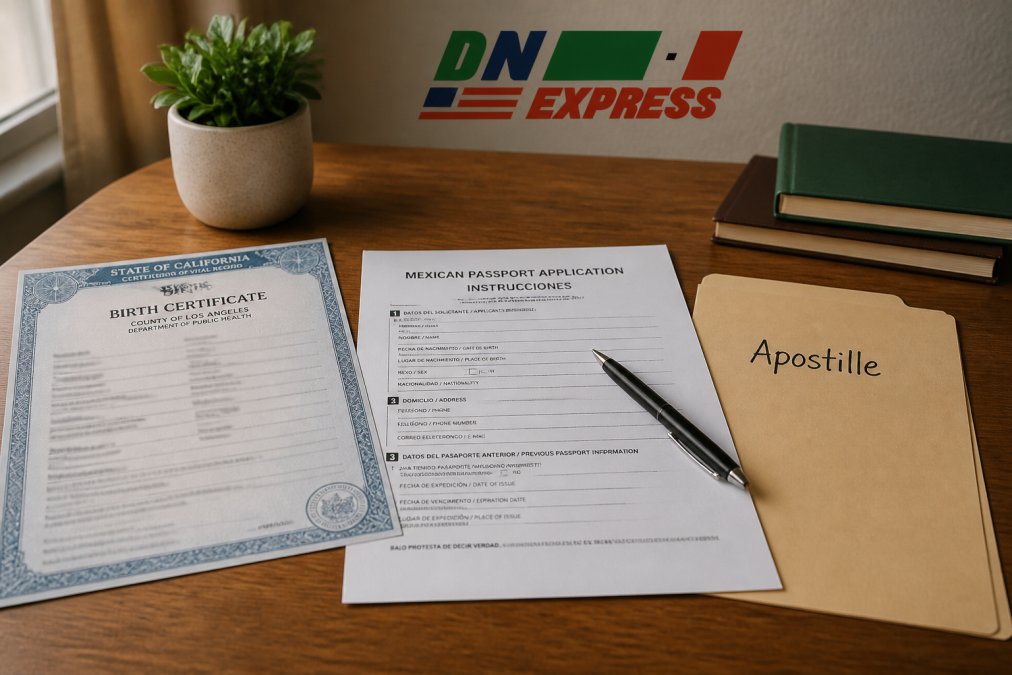
The core document set for a descent claim is a certified copy of your foreign birth certificate, a certified copy of your Mexican parent’s birth certificate, and your government-issued photo identification. Every foreign-issued document needs an apostille and a sworn translation into Spanish.
Apostille and Sworn Translation Basics
An apostille is the certification that authenticates a public document for use in another country. It must come from the issuing authority in the state where your document was issued, not from a notary. A sworn translation is a Spanish rendering prepared and signed by a translator authorized by Mexican authorities, and a plain translation from a general service will be turned away.
Filing a document translated by a non-certified translator is one of the most common reasons applications get bounced. You lose weeks and often pay twice, because the certified translation must be redone from scratch.
Mexican Naturalization Process Timeline
Naturalization is the pathway for people without a Mexican parent or grandparent, and it runs on residency, not heritage. The Mexican government’s official immigration portal publishes the current categories and forms, and requirements shift, so verify against the official source before you commit to a timeline.
Residency Duration by Category
The residency clock is the single most misunderstood part of the process. The Secretaría de Relaciones Exteriores (SRE) sets the qualifying periods, and they differ by how you entered and whether you have family ties:
- Two years, for applicants with a Mexican child, a Mexican spouse, or a Mexican parent, and for holders of certain permanent residency categories tied to family unity.
- Four years, for applicants who hold temporary residency and later convert to permanent residency without a qualifying family link.
- Five years, the standard baseline for most other permanent residents who do not fall into a shorter category.
These figures are the statutory minimums, not guarantees. The SRE reviews the file as a whole, and a clean residency history matters as much as the raw number of years.
How the Clock Actually Counts
The clock only counts time in valid immigration status. A gap between a temporary residency card expiring and a permanent card being issued does not just pause the count, it can reset the eligibility window, forcing you to start over. This is why the temporary-to-permanent conversion is the highest-risk step in the entire timeline.
Two other rules trip people up:
- Physical presence. You generally must be physically present in the country for the period immediately preceding your application, and extended absences can be treated as breaking continuous residence. Keep entry and exit records.
- Status continuity. Changing categories, letting a card lapse, or overstaying a permit all create problems that surface only at the interview stage, when it is expensive to fix.
The Application Sequence
Once you meet the residency threshold, the process runs roughly in this order:
- Confirm eligibility against your specific residency category and presence history.
- Assemble the file, residency cards, passport, birth certificate, and the apostilled and sworn-translated documents described above.
- File the solicitud with the SRE and pay the applicable government fee.
- Sit the history and culture exam and the Spanish-language assessment.
- Attend the interview, where an officer reviews your documents and questions you on your application.
- Receive the resolution and, if approved, complete the carta de naturalización and the post-approval registrations covered below.
Processing Times and Fees
Processing times vary widely by office and by how complete your file is. A common pattern is several months from filing to resolution, with document corrections adding weeks on top. Government fees are set in pesos and adjusted periodically, so confirm the current amount on the official portal rather than relying on a figure quoted in an older guide. Budget time for the apostille and translation work before you file, that preparation, not the SRE review, is usually the longest part of the calendar.
Do not let your temporary residency lapse while you wait for a permanent card. A lapse in valid status is the most common reason a naturalization clock resets, and it can add years to your timeline.
The History and Culture Test: What to Expect
The history and culture exam is a Spanish-language assessment covering Mexican history, geography, and civic knowledge, and it is required for naturalization applicants. It is not a formality. Preparation matters, and the test is administered in Spanish, so language proficiency and subject knowledge are tested at the same time.
Most guides gloss over the specifics. This section does not, it breaks down what the exam actually covers, how it is scored, and how to study for it.
What the Exam Covers
The SRE administers the exam, and the question pool draws from a defined body of material. In practice, the topics cluster into four buckets:
- History, pre-Columbian civilizations, the colonial period, the independence movement, the Reform era, the Revolution, and major twentieth-century developments.
- Geography, states and capitals, major regions, bodies of water, and national territory.
- Civics and government, the structure of the federal government, the Constitution, the branches of power, and national symbols.
- Culture, national holidays, traditions, and figures commonly recognized as part of the national story.
How It Is Scored
The exam is typically multiple-choice, and the passing threshold is a defined percentage of correct answers rather than a curve. You sit the exam in Spanish, and there is generally a limited number of attempts if you do not pass on the first try, with a waiting period before a retake. Confirm the current passing score and retake rules with the SRE, because they are set administratively and can change.
Sample Questions to Gauge Your Readiness
These illustrate the format and difficulty. They are representative, not actual exam items:
- ¿En qué año inició la Guerra de Independencia de México? (1810)
- ¿Cuál es la capital del estado de Jalisco? (Guadalajara)
- ¿Cuántos poderes conforman el gobierno federal de México? (Tres: ejecutivo, legislativo y judicial)
- ¿Qué documento establece los derechos fundamentales en México? (La Constitución)
- ¿Quién fue Benito Juárez y por qué es una figura central? (A nineteenth-century president and reform leader)
If you cannot answer most of these in Spanish without hesitation, you are not ready.
How to Study
A targeted study plan beats memorizing trivia:
- Start with the structure, not the details. Learn the arc of Mexican history, the periods and the major turning points, before drilling dates.
- Study in Spanish. Reading English-language summaries helps you learn the facts but does not build the language fluency the exam tests. Use Spanish-language study materials so you practice both at once.
- Use official and reputable resources. The SRE publishes study guidance, and established Mexican history texts and civics primers cover the same ground the exam draws from.
- Practice under exam conditions. Time yourself on multiple-choice sets so the format is familiar on the day.
The Language Component
The exam is not a separate language test, but it functions as one. A common mistake is underpreparing the language side and losing points on questions the applicant actually knew. If your Spanish is conversational but not academic, build vocabulary for history and civics specifically, the register is different from everyday speech.
Study the material in Spanish from day one. Applicants who learn the facts in English and then try to translate on exam day consistently underperform those who studied in the language they will be tested in.
Dual Nationality Rules and Renunciation of Previous Citizenship
Mexico permits dual nationality, which means you do not have to give up your U.S. citizenship to become Mexican. The U.S. also allows dual nationality, so there is no forced choice on either side. What matters is that you present yourself to each government as its own citizen when you enter and exit, and you carry the correct passport for each leg of travel.
Use your U.S. passport to enter and leave the United States, and your Mexican passport to enter and leave Mexico. Mixing them up at the border is the single most common practical headache dual nationals run into.
Post-Naturalization Steps: Passport, CURP, and Tax Implications
Approval is not the finish line. After your citizenship is recognized, you still need to register your CURP, obtain your Mexican passport, and update your official identification. These administrative steps are what most applicants underestimate, and they are what actually let you work, own property, and access services.
The tax picture deserves attention too. The United States taxes citizens on worldwide income, so becoming a Mexican citizen does not remove your U.S. filing obligation. Mexico taxes residents on their income as well, and the two systems interact through treaty provisions. If you split time between both countries, talk to a cross-border tax professional before you assume your situation is simple.
| Step | What You Do | Why It Matters |
|---|---|---|
| CURP registration | Register your national identity number | Required for banking, employment, and services |
| Passport issuance | Apply for your Mexican passport | Enables visa-free travel and re-entry |
| Official ID update | Align your identification records | Prevents future document mismatches |
| Tax review | Confirm filing obligations in both countries | Avoids penalties on either side |
DNExpress supports clients through these post-approval steps, including passport appointment scheduling and vital record corrections, so the process does not stall after the hard part is done.
Common Mistakes and How to Avoid Them
The most damaging mistakes are almost always documentary, not legal. Applicants file with uncorrected name discrepancies, skip the apostille, or submit translations that fail certification. Third-generation applicants often assume they do not qualify and never file at all, when a grandparent link frequently does work with the right records.
A second recurring problem is timing. People who need citizenship to buy property or relocate on a deadline start the process too late, then scramble. Building in buffer time for document corrections and consulate appointments is what separates a smooth application from a stressful one.
Correct your source documents first, then file. Fixing a discrepancy before submission takes days; fixing it after a rejection takes months.
Getting Mexican citizenship is a documentation problem more than a legal one, and the applicants who succeed are the ones who treat their records as the real work. Doble Nacionalidad Express (DNExpress) was built for exactly this: our 4-step process, expert handling of paperwork and government correspondence, and document search, translation, and correction services mean your file is managed correctly from start to finish. Our team is rated 4.9 based on 632 reviews, and clients like Melinda Rivas note that we “simplified the process, expedited the process, and were courteous and professional throughout.” Book a free consultation with DNExpress and secure the citizenship you already qualify for.
Frequently Asked Questions
Can I have dual citizenship in Mexico and the US?
Yes. Mexico allows dual nationality, and the United States permits its citizens to hold another passport. You do not have to give up your U.S. citizenship to become a Mexican citizen. However, you will take an oath of allegiance to Mexico during the naturalization process. This oath does not automatically revoke your U.S. citizenship, but it is a formal commitment to Mexican law. Many U.S. citizens hold both passports without issue.
How does Mexican citizenship by descent work for U.S. citizens?
If you were born outside Mexico to at least one Mexican parent, you are considered Mexican by birth. You can claim citizenship by presenting your foreign birth certificate, your parent’s Mexican birth certificate, and your parent’s official identification. The process is done through a Mexican consulate or the Civil Registry. For grandparents, the rules are stricter, but second-generation claims are often possible with proper documentation.
What documents are needed for Mexican citizenship?
You will need your foreign birth certificate (apostilled and sworn-translated), your Mexican parent’s birth certificate, a valid passport, your CURP if you have one, and completed application forms. If your name or dates differ between documents, you will need to correct them first. A background check and biometric data may also be required. Always check the consulate’s current list, as requirements can change.
How long does the Mexican naturalization process timeline take?
For citizenship by descent, the process can take several months, depending on consulate backlogs and document corrections. For naturalization by residency, the application review can take several months. Timelines vary widely, so plan ahead if you have a deadline like a property purchase.
Is it possible to lose my U.S. citizenship by becoming a Mexican citizen?
No, the United States allows dual citizenship. Taking an oath of allegiance to Mexico does not automatically strip your U.S. citizenship. However, if you apply for a Mexican passport and use it to enter the U.S., you must still use your U.S. passport to exit and enter the United States. As long as you do not formally renounce your U.S. citizenship, you retain it.
What is the difference between residency and citizenship in Mexico?
Residency gives you the legal right to live in Mexico, either temporarily or permanently, but you remain a foreign national. Citizenship grants you a Mexican passport, the right to vote, and full legal status. Residency is often a stepping stone to citizenship through naturalization, but if you qualify by descent, you can skip residency entirely and apply directly for citizenship.